Fraud Detection in Finance: How Dataverses Turns Data into Your First Line of Defense
The $485 Billion Problem That Keeps CFOs Up at Night
In 2023, fraud scams and bank fraud schemes totaled $485.6 billion in projected losses globally. For banks, fintechs, insurers, and payment processors, the challenge isn't just catching fraud - it's catching it fast enough. Every minute a fraudulent transaction goes undetected, the cost compounds: chargebacks pile up, customer trust erodes, and regulatory exposure grows.
Traditional fraud detection relies on batch processing - running overnight queries against yesterday's transactions. By the time a suspicious pattern surfaces, the money is gone.
What if your fraud detection could work in real time, across all your data, without requiring a team of engineers to maintain it?
That's exactly what Dataverses makes possible.
From Raw Transactions to Real-Time Fraud Signals - In One Platform
Dataverses is a unified data platform that brings together data ingestion, streaming, analytics, and AI in a single workspace. For fraud detection, this means your team can build an end-to-end pipeline - from capturing raw transaction data to surfacing fraud alerts on a live dashboard - without stitching together a dozen tools.
Here's how a financial institution can use Dataverses to detect fraud at every stage:
1. Connect to Every Data Source - In Minutes
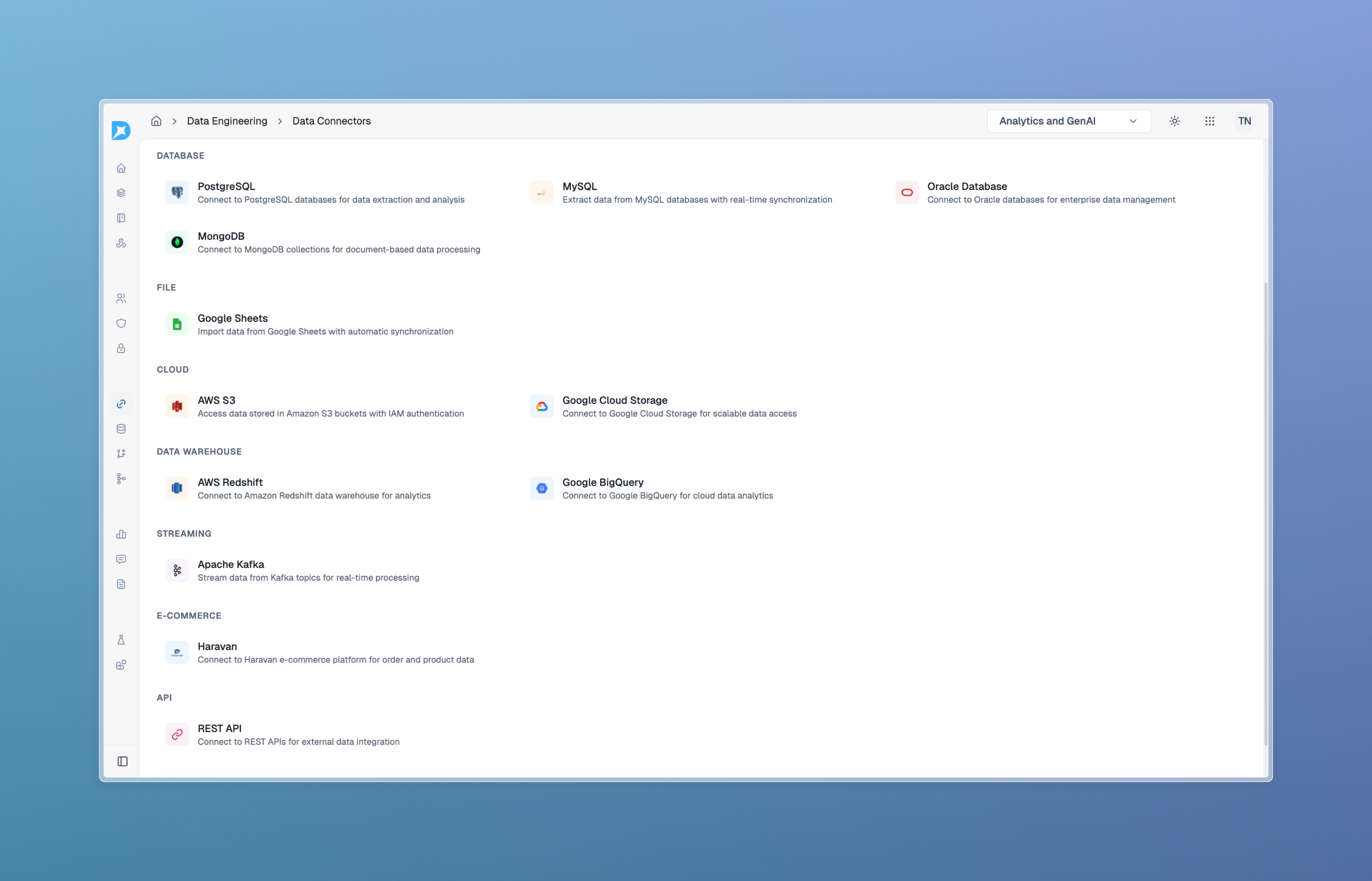 Fraud hides in the gaps between systems. A suspicious wire transfer might look normal on its own, but cross-referenced with login location data, device fingerprints, and historical spending patterns, it stands out immediately.
With Data Connectors, you can plug into your core banking system, payment gateway, CRM, and third-party risk feeds - all from a visual marketplace. Dataverses supports databases like PostgreSQL, MySQL, and MongoDB, cloud storage on AWS S3 and Azure Blob, REST APIs, and real-time Kafka streams.
No code. No infrastructure tickets. Just select a connector, configure the credentials, and your data starts flowing.
2. Ingest Transaction Data Continuously with CDC Pipelines
Fraud detection demands fresh data. Dataverses's Data Ingestion engine supports Change Data Capture (CDC) pipelines that mirror your transactional databases in near real time.
Using a guided 5-step wizard, your data team can set up an ingestion job that captures every insert, update, and delete from your source tables - transactions, accounts, merchant records - and lands them in a centralized data lakehouse.
The Monitoring tab on each ingestion job gives you full visibility into lag, throughput, and record counts, so you always know your fraud models are running on the freshest data.
3. Stream and Process Events with Kafka and Spark
For real-time fraud scoring, batch processing isn't enough. Dataverses provides managed Kafka clusters for event streaming and Spark clusters for large-scale processing - both configurable directly from the platform.
- Kafka captures transaction events the moment they occur, with configurable replication, partitioning, and retention policies to ensure no event is lost.
- Spark processes those events at scale - running rule-based checks, anomaly detection, and ML model inference across millions of transactions per second.
Spin up a cluster, configure autoscaling to handle peak transaction volumes (think Black Friday or month-end payroll), and let the platform manage the infrastructure.
4. Orchestrate Fraud Detection Workflows Visually
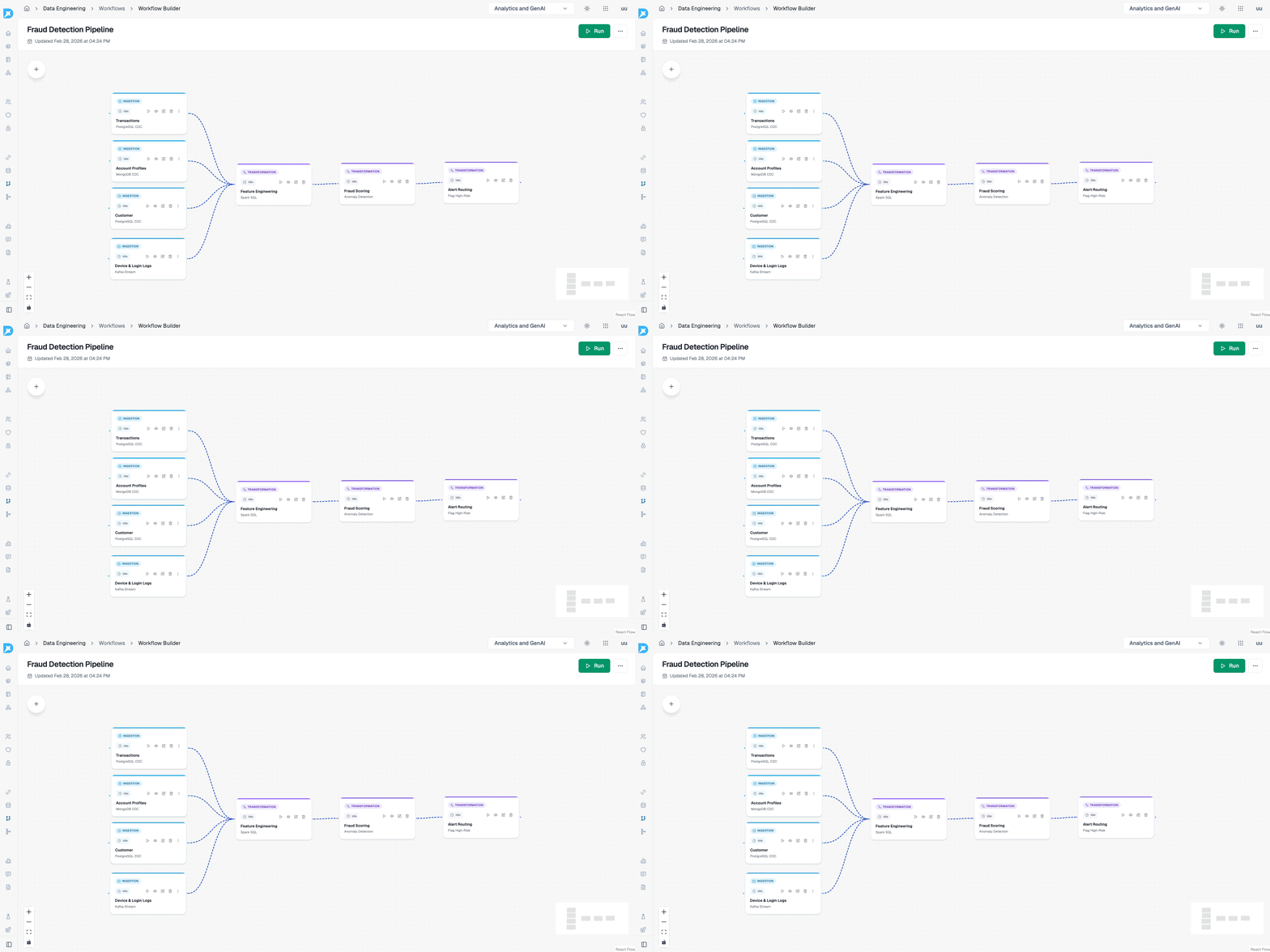
A fraud detection pipeline isn't a single query - it's a series of steps: data enrichment, feature engineering, model scoring, alert generation, and case routing.
With the Workflow Builder, your team designs these pipelines on a visual canvas using three node types:
- Ingestion nodes - pull in fresh transaction and reference data.
- Transformation nodes - run Spark SQL to compute fraud features (e.g., transaction velocity, geo-distance from last purchase, amount deviation from average).
- AI nodes - invoke ML models or LLM-powered agents for intelligent scoring and reasoning.
Connect the nodes, configure each one, and hit Run. The Jobs page tracks every execution with status, duration, and detailed logs.
5. Ask Questions in Plain English with Seraphis Agent
Not every fraud analyst writes SQL. Seraphis Agent is Dataverses's AI-powered conversational analytics engine. It lets business users ask:
"Show me all transactions above $10,000 in the last 7 days from accounts flagged as high-risk."
Seraphis translates the question into validated SQL, runs it against your data catalog, and returns results as interactive tables and charts - complete with the underlying query for full transparency.
This means your compliance officers and fraud investigators can explore patterns, drill into suspicious activity, and generate evidence - without waiting for the data team.
6. Build AI-Powered Fraud Agents with Agent Builder
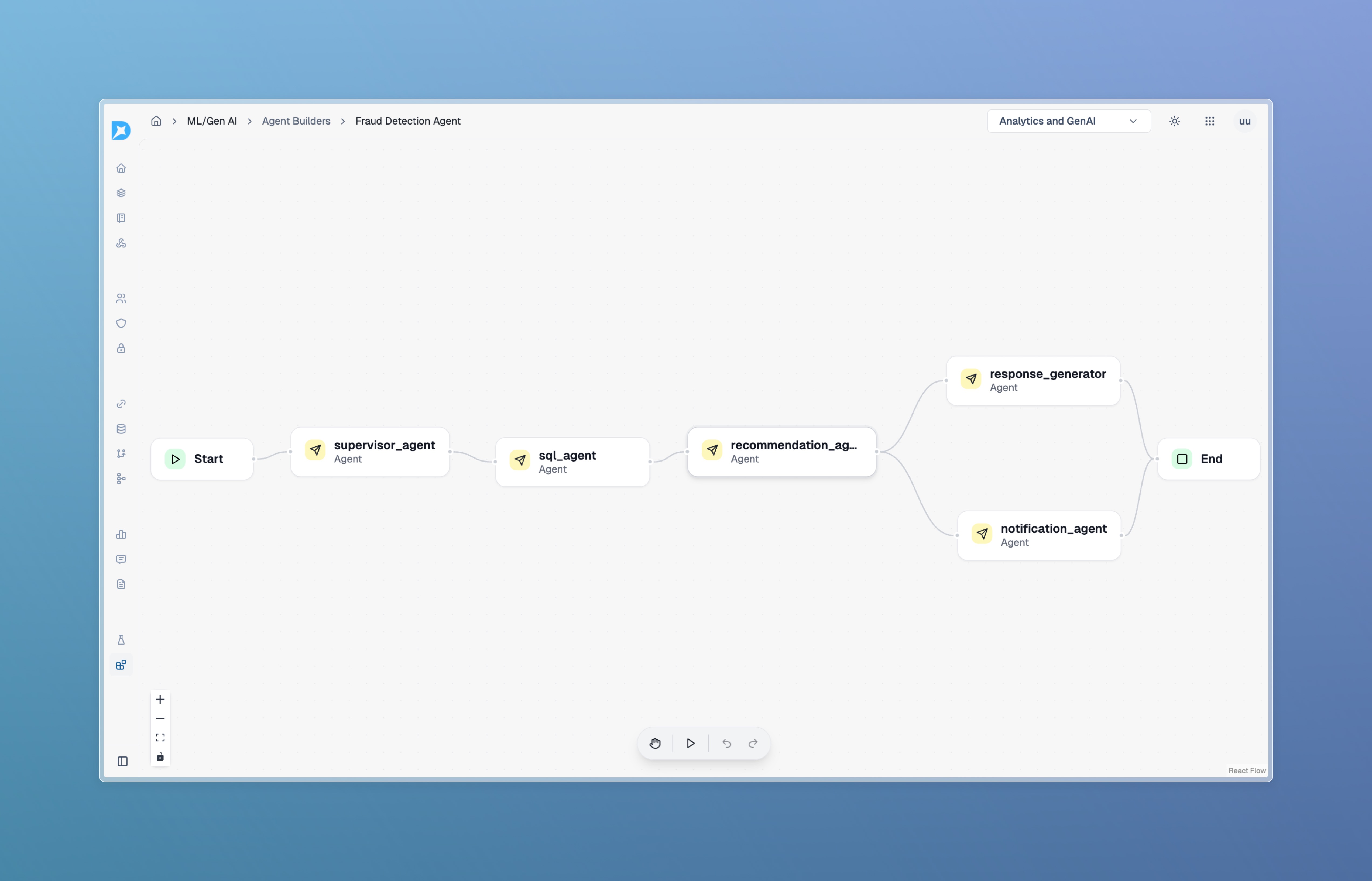
For advanced fraud operations, Dataverses's Agent Builder lets you design multi-agent AI systems on a visual canvas. Think of it as assembling a team of specialized AI agents:
- A supervisor_agent that orchestrates the investigation workflow.
- A sql_agent that queries transaction data and account history.
- A recommendation_agent that cross-references patterns with known fraud typologies.
- A response_generator that drafts case summaries for the compliance team.
- A notification_agent that triggers real-time alerts to affected customers via SMS, email, or push notification when suspicious activity is detected on their accounts.
Each agent is independently configurable - choose the LLM provider, set the temperature for deterministic or creative responses, assign tools like execute_spark_sql and get_table_info, and define the coordination pattern (Supervisor, Sequential, or Swarm).
You can also integrate external notification services - such as Twilio, SendGrid, Slack, or PagerDuty - as custom tools within your agent workflow. For example, when the recommendation agent flags a transaction as high-risk, the notification agent can immediately alert the account holder with a one-tap "Confirm or freeze" action, giving victims the power to respond within seconds rather than discovering the fraud days later on a bank statement.
The result: an AI-powered fraud investigation system that runs 24/7, triages cases faster than any manual process, and proactively protects customers by notifying them the moment suspicious activity is detected.
7. Monitor Everything on Live Dashboards
When fraud is detected, speed of response matters. Dashboards in Dataverses give your fraud operations team a real-time command center:
- KPI cards - total alerts today, false positive rate, average detection-to-resolution time.
- Trend charts - fraud volume by hour, by region, by transaction type.
- Filter-driven exploration - drill into specific merchant categories, geographies, or dollar ranges.
Dashboards run on your selected compute cluster and support multiple tabbed views, so your frontline analysts, team leads, and executives each see the view they need.
8. Generate Compliance Reports Automatically
Regulatory reporting - SAR filings, audit trails, pattern-of-life analyses - is one of the most time-consuming parts of fraud operations. The Reporting Agent automates this.
Walk through a 6-step wizard:
- Select your report type.
- Choose the data source and compute cluster.
- Define the time range and granularity.
- Pick the metrics (e.g., Total Flagged Transactions, Loss Amount) and dimensions (e.g., Region, Account Type).
- Add context for the AI (e.g., "Focus on transactions exceeding the $10,000 CTR threshold").
- Review and generate.
The AI produces a structured, data-backed report ready for internal review or regulatory submission.
The Business Value: Why Finance Teams Choose Dataverses
| Challenge | Without Dataverses | With Dataverses |
|---|---|---|
| Detection speed | Hours to days (batch processing) | Seconds to minutes (real-time streaming + Spark) |
| Data silos | Fraud signals scattered across 5+ systems | Unified data lakehouse with 12+ native connectors |
| Analyst productivity | SQL-dependent, backlogged with ad-hoc requests | Self-service with Seraphis AI and interactive dashboards |
| Investigation throughput | Manual case-by-case review | AI agent teams that auto-triage and summarize cases |
| Compliance reporting | Manual report assembly, weeks of effort | AI-generated reports in minutes via Reporting Agent |
| Infrastructure management | Separate tools for Kafka, Spark, BI, and ML | One platform - managed clusters, auto-scaling, zero ops |
Get Started
Fraud doesn't wait. Neither should your data platform.
With Dataverses, your finance team can go from raw transaction data to real-time fraud detection - with dashboards, AI agents, and automated compliance - in a single, unified workspace.
Start building your fraud detection pipeline today.
Tags
Keep up with us
Get the latest updates on data engineering and AI delivered to your inbox.
Contents in this story
Recommended for you
Code Smarter, Not Harder: Meet the New Notebook Code Generation on Dataverses
May 23, 2026 · 4 min read
Apache Iceberg 1.11.0 Release: Deletion Vectors, Variant Type, and V3 Maturity
May 22, 2026 · 7 min read
Spark Declarative Pipelines in Apache Spark 4.1: A Complete Guide
May 1, 2026 · 7 min read